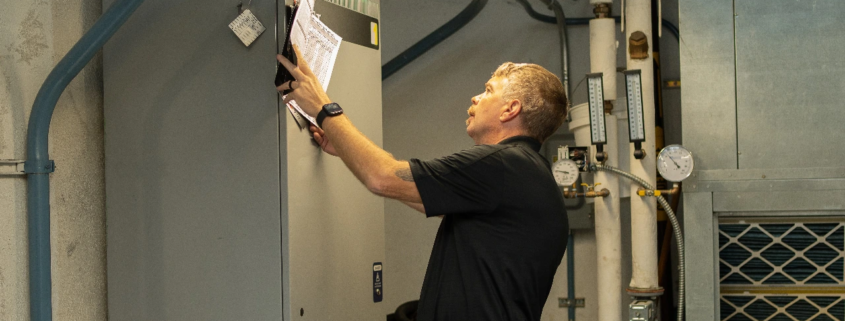
Elevators play a critical role in keeping buildings safe, functional, and accessible. To ensure they continue to operate safely and efficiently, inspections and code testing must be conducted regularly by qualified personnel.
The purpose of elevator inspections and testing is to extend the life, functionality, and compliance of the equipment, and most importantly, to protect both the workers who maintain it and the riding public. Routine testing also verifies that systems perform in accordance with the ASME A17.1/CSA B44 Safety Code for Elevators and Escalators, ensuring that equipment remains operationally sound throughout its service life.
All testing and maintenance are conducted under a Maintenance Control Program (MCP), in compliance with the applicable code edition enforced by the Authority Having Jurisdiction (AHJ). These inspections ensure that elevators meet all safety and performance standards established at the time of installation or alteration, as required by ASME A17.1.
Regular Code Compliance Testing
Code compliance testing verifies that an elevator continues to meet safety and performance standards after installation. These tests check critical systems and confirm that the elevator functions safely under normal and emergency conditions.
ASME A17.1 Safety Code for Elevators and Escalators outlines the required periodic testing schedules, which include the Category 1 Annual Test for both electric and hydraulic elevators. ASME A17.2 Guide for Inspection of Elevators, Escalators, and Moving Walks describes the proper procedures to perform the tests on the applicable components.
It is important to note that these codes are updated periodically, and you can also read about the differences between the two latest versions of ASME A17.1 here.
Actions described in the following sections are taken from the A17.2-2020 guide for inspection of elevators, escalators, and moving walks.
Category One Testing of Electric Elevators (Every 12 Months)
Category 1 testing is required every 12 months; below are the periodic tests of electric elevators (ASME A17.1 Safety Codes for Elevators and Escalators, Section 8.11.2 Periodic Inspections and Witnessing of Tests). 8.11.2.1 stipulates that applicable components shall be inspected in these areas: Inside the Car, Machine Rooms, Machinery Spaces and Control Rooms/Spaces, Top of Car, Outside Hoistway, Pit, Firefighters Emergency, and the Braking System.
Periodic tests include, but are not limited to:
- Car lighting and receptacles / car emergency signals
- Driving machine brakes
- Door closing speeds
- Detection means of objects in the door path: mechanical reopening device, electronic reopening, and photoelectric reopening
- Standby power operation
- Spring-return buffers
- Gas spring-return buffers
- Governor test, overspeed switch, and seal testing
- Car and counterweight safeties
- Slack-rope devices on winding drum machines
- Test of normal terminal stopping device
- Final and emergency terminal stopping device
- Test of firefighters’ emergency operation
- Test of broken rope, tape, or chain switch
- Test of static controls
- Test of emergency brake, ascending car overspeed protection, and unintended car movement
- Test of AC drives from a DC source
- Test of emergency communications
- Means to restrict hoistway or car door opening
- Test of gears, bearings, and flexible couplings
- Earthquake operation
Category One Testing of Hydraulic Elevators (Every 12 Months)
Category 1 testing is required every 12 months; below are the periodic tests of hydraulic elevators (ASME A17.1 Safety Codes for Elevators and Escalators, Section 8.11.2 Periodic Inspections and Witnessing of Tests). 8.11.2.1 stipulates that applicable components shall be inspected in these areas: Inside the Car, Machine Rooms, Machinery Spaces and Control Rooms/Spaces, Top of Car, Outside Hoistway, Pit, Firefighters Emergency, and the Braking System.
Periodic testing includes but is not limited to:
- Test of hydraulic cylinders
- Test of standby power
- Test of emergency terminal speed limiting device and emergency terminal stopping device
- Test of flexible hydraulic hose and fitting assemblies
- Test of pressure switch
- Test of governor, overspeed switch, and seal
- Test of safeties
- Test of door closing force
- Test of power operation of door system
- Test means to restrict hoistway or car door opening
- Test of emergency communications
- Test of oil buffers
- Test of firefighters’ emergency operation
- Test of power operation of door systems
- Test of low oil protection
- Test of slack-rope device
- Test of earthquake operation
These tests, performed under the MCP, ensure that all safety devices continue to function as designed, maintaining compliance with the most recently adopted edition of ASME A17.1.
Long-Term Safety Testing
In addition to annual testing, more comprehensive inspections occur on a multi-year schedule to verify the full operational integrity of elevator systems.
Category Five Testing of Electric Elevators (Every 5 Years)
Code requires Category 5 testing be performed by qualified elevator personnel and witnessed by a Qualified Elevator Inspector every five years. These tests are more intensive and include all of the component testing for Category 1 tests plus:
- Full Load testing with weights
- Car and Counterweight Safeties
- Governors
- Oil Buffers
- Driving Machine Brake(s)
- Emergency Terminal Stopping and Speed Limiting Devices
- Power Opening of Doors
- Leveling Zone and Leveling Speed
- Inner Landing Zone
- Braking System, Traction, and Traction Limits
- Emergency Brake
- Drive Sheaves with Nonmetallic Groove Surfaces and Steel Wire Ropes (if applicable)
Category Three Testing of Hydraulic Elevators (Every 3 Years)
Conducted every three years, these tests evaluate:
- Unexposed portions of pistons
- Pressure vessels
- Roped or water hydraulic systems
Category Five Testing of Hydraulic Elevators (Every 5 Years)
Performed every five years, these include all of the components of the Category One tests plus:
- Full load and static tests with weights
- Governor tests
- Safety tests for roped hydraulic systems
- Coated rope flux testing
- Wire rope fastening tests
- Plunger gripper testing
- Overspeed valve testing
- Class 2 load tests
- Test of power-opening of doors and gates
These comprehensive evaluations confirm that all safety components continue to perform under rated load and emergency conditions, ensuring the elevator’s ongoing compliance and reliability.
Who Performs Elevator Inspections
All testing should be performed by qualified elevator personnel and witnessed by Qualified Elevator Inspectors. Check with the AHJ in your area regarding their requirements.
Inspectors are also governed by the QEI-1 (Qualified Elevator Inspector) Standard, which outlines job duties, reporting requirements, and competency expectations under ASME A17.1.
Equipment Age
Code dictates that all tests have to be done in compliance with the code requirements at the time of installation or alteration. That is to say, the time that the equipment was installed determines what edition of the code must be applied during the inspection.
For example, if an elevator was installed in 1984, it would be required to comply with the version of the ASME A17.1 standard adopted by that local AHJ in 1984. If that elevator has never been altered or modernized since its installation in 1984, it only needs to meet the requirements established by its local AHJ in 1984, and would be tested according to those guidelines.
This is not the case for elevators that have been altered modernized since their installation – these elevators must be tested under the code adopted by the AHJ at the time of the alteration (modernization).
Door restrictors are one such example of something not required in older versions of the code but that are addressed in later editions. Ultimately, compliance depends on how the Authority Having Jurisdiction (AHJ) has implemented and enforced the standards within its regulatory framework. This can vary across the country, but safety features such as door restrictors are generally recognized as life-saving devices for the riding public.
Final Thoughts
Elevator inspections are more than a regulatory requirement – they are the foundation of safe, reliable transportation within every building. By following the Maintenance Control Program (MCP) and adhering to all relevant ASME A17.1 and A17.2 standards, building owners can help ensure that their systems remain in full compliance, reduce costly downtime, and extend equipment life.
When performed by IUEC-trained and licensed elevator mechanics, inspections are completed with precision, care, and a deep understanding of code compliance. Routine inspections safeguard lives, preserve investment, and keep the riding public moving with confidence.