Jack Demmel

How many individuals do you know who were able to afford buying their own house through hard earned wages before they were old enough to buy a beer?

ElevatorInfo recently caught up with a young man who did just that. Jack Demmel, a fourth-year apprentice in the organized elevator industry, will sit for the Mechanic Examination in 2023.

“Once I’ve successfully completed the Mechanic Examination, I’ll no longer be classified as an apprentice,” said Demmel. “I’ll advance to mechanic status.”

The 22-year-old shared with us his journey to the elevator trade. While Demmel did grow up around plenty of people who made a name for themselves in the elevator industry, his path was not necessarily a traditional one.

“I had the grades for college, so after graduating from high school, I gave college life a shot,” said Demmel. “I ended up at Prince George’s Community College for a single semester – then I realized that I was actually happiest when working with my hands. For me, a fulfilling career would challenge me both mentally and physically.”

After completing the recruitment process, Demmel soon was hired as a union elevator constructor and began taking classes through the National Elevator Industry Educational Program (NEIEP), a U.S. Department of Labor-registered apprenticeship program offering craft training – in the classroom and also in the field – for all employees covered by the agreement between signatory contractors and the International Union of Elevator Constructors (IUEC).

“NEIEP has been great. Not only have I participated in online and in-person classroom training, I have also been provided with a variety of hands-on training opportunities,” said Demmel.

When asked about his early days in NEIEP compared to his experience now as a fourth-year apprentice, Demmel expressed that NEIEP’s training is the reason he feels confident working in such a complex trade.

“I’ve always felt that I was mechanically inclined, but being a smart, safe mechanic requires more than a general knowledge of how to fix things,” said Demmel. “Thanks to my NEIEP instructors and the leadership at IUEC Local 10, everything I do feels like second nature. What’s more, I have found lasting friendships within the elevator trade. The people I study with and work alongside all have a team-first mentality – I’m very happy.”

Demmel went on to explain that, as far as enrollment fees and other charges related to NEIEP, there have been no out-of-pocket costs. People from all walks of life are welcome to participate in the recruitment process. This opens the door to a rewarding career, family-sustaining wages, and a dignified retirement – thanks to the training funded by contributions from IUEC signatory contractor partners.

“If young people are ready to work hard to secure the future they want for themselves and their families, the union elevator industry is a smart path to take,” said IUEC Local 10 Business Manager and IUEC Executive Board Vice President John O’Connor. “The earn-as-you-learn approach means our apprentices don’t incur student debt. Instead, they earn wages and benefits as they learn the elevator trade. It is a career choice that I wish more hardworking young people knew about – and knew about sooner.”

Escalator safety

Did you know that when riding an escalator some footwear, including foam clogs and flip-flops, can be dangerous? Every year, children and adults sustain injuries to their toes and feet at shopping malls, hotels, and other areas with escalators.

According to ABC News article, some people have reported that kids wearing foam clogs have had their feet sucked into the side of escalators.

Luckily, companies including Schindler Elevator Corporation and groups like the Elevator Escalator Safety Foundation have published useful escalator safety tips for the riding public. While some tips may seem like common sense (e.g., step on and off carefully), there are other things you may not have considered. It is especially critical to review these safety tips with children.

Below is a list of escalator safety tips from Schindler’s website:

  • Watch the direction of the moving step and step on and off with extra care.
  • Take care if you are wearing bifocals or similar eyewear.
  • Hold children firmly with one arm or hold child’s free hand.
  • Hold small packages firmly in one hand, but always leave one hand available to hold the handrail.
  • Grasp the handle as you step onto the moving step.
  • Do not go in the opposite direction of the escalator.
  • Do not take wheelchairs, electric scooters, strollers, hand carts, luggage carts or similar items on the escalator.
  • When riding escalators: Keep loose clothing clear of steps and sides.
  • Wear closed-toed and hard-soled shoes, and avoid wearing footwear made of soft-resin or other rubbery materials.
  • Stand clear of the sides of the escalator.
  • Face forward and keep firm grip on the handrail.
  • Reposition your hand slowly if the handrail moves ahead or behind the steps.
  • Don’t climb onto or ride the handrail.
  • Do not let children sit on steps or stand too close to sides.
  • When exiting escalators: Don’t hesitate and step off promptly.
  • Make sure to step over the comb fingers; don’t let your feet slide off the end of the escalator.
  • Immediately move clear of the escalator exit area; don’t stop to talk or look around since other passengers may be behind you.

While the list of safety tips included in this post is surely thorough, remember that, in the event of an emergency, pushing the “STOP” button at the top or bottom of an escalator will immediately halt the machine.

Also, if you have children in your life, ElevatorInfo would like to introduce you to the Elevator Escalator Safety Foundation. EESF, the leading resource for educational programs that teach children and adults how to properly ride elevators, escalators, and moving walks safely, has an excellent website that offers plenty of practical, hands-on methods to help kids learn about safe riding rules on elevators, escalators, and moving walks.

join IUEC

The International Union of Elevator Constructors (IUEC) offers elevator apprentices more than stable elevator union jobs and elevator union wages – it offers a lifetime career that for most members has spanned generations. The IUEC offers union elevator careers, an elevator union salary, and ultimately an elevator crew that always has your back.

You’re Never Too Young to Score a High-Ranking Career

No more significant experience exists for young people to start a career than in the elevator apprenticeship program(s) of the IUEC. The National Elevator Industry Educational Program (NEIEP) is available to applicants at least 18 years of age, with a high school diploma or a state-approved GED.

Candidates can apply to the elevator union apprenticeship program at the available locations listed on the NEIEP career page. NEIEP Area Coordinators will invite applicants to take part in the Elevator Industry Aptitude Test (EIAT), consisting of three sections: basic mathematics, verbal reasoning, and mechanical skills.

To pass the EIAT, applicants must score at least 70%. After you’ve passed the test, you’ll be contacted and scheduled for an interview by representatives of the Joint Apprenticeship Committee (JAC) – an IUEC representative and an employer representative. You’ll also complete a tool assessment, where applicants are asked to identify specific working tools. There are many IUEC signatory employers across North America, including the global industry leaders Otis, Schindler, Kone, Fujitec, Mitsubishi and TK Elevator. You are never too young to start the best blue-collar career and secure your future.

What Certification/Preparation is Best to Complete Before Your Elevator Apprenticeship Interview?

Applicants who wish to enroll in the IUEC’s elevator constructor apprenticeship program need at minimum a high school education or its GED equivalent. As an aspiring elevator apprentice, it will be helpful if you have previously taken courses in physics, electricity, and mathematics. Additionally, possessing knowledge and skills in reading a tape measure and following instructions are beneficial. Shop courses on carpentry, welding, pipefitting, or electrical work also provide a decisive advantage.

Continuing Education and Training

Continuing education is essential to the IUEC elevator mechanic’s success as well as way of life, and it all starts within the NEIEP apprenticeship program.

After you have passed the EIAT and final interview, you will be placed on a ranked list. When a position opens, you’ll be called by the IUEC to begin work as a probationary employee, and you will start your college-level NEIEP apprenticeship program. This consists of over 8,000 hours of on-the-job learning (OJL) where you earn while you learn, as well as a minimum of 576 hours in theoretical and practical courses of related instruction.

During your apprenticeship OJL, you will work and learn under the supervision of your IUEC mechanic performing all aspects of elevator installation, modernization, and repair – all while you learn the theoretical aspects of the trade one night a week in the NEIEP classroom. During these courses, instructors will cover subjects such as electrical fundamentals, hoistway structures, solid state theory and application, power and logic, and many others.

During your time as an elevator apprentice, you will be working on the installation, repair, and maintenance of passenger and freight elevators, escalators, dumbwaiters, or moving sidewalks.

Elevator Apprentices Get Paid to Learn

Unlike other educational programs in which you usually pay to learn, in the NEIEP Apprenticeship Program, YOU are the one getting paid to learn. During your apprenticeship, you earn a percentage of the mechanic’s rate, increasing upon completion of two semesters until after your eight semesters are completed and you pass your mechanic exam.

During the first six months, you are a probationary apprentice and earn 50% of the mechanic’s rate. As a first-year apprentice, you make 55%, as a second-year, 65%, third-year, 70%, and, finally, as a fourth-year apprentice, 80%.

You Get All the Benefits Sooner

Because employers have signed a Collective Bargaining Agreement (CBA) with the IUEC, they are bound to make fringe benefits on behalf of the employees that work under the agreement. This means that, by federal law, employers make contributions to the National Elevator Industry Pension Fund, the National Elevator Industry Health Benefit Plan, the National Elevator Industry Educational Program, and the Elevator Constructors Annuity and 401(k) Retirement Plan and the Elevator Industry Work Preservation Fund on your behalf.

Bottom line: you get all of those benefits by joining the IUEC.

So Why Overthink?

Most members of the IUEC say they wished they had joined it earlier in their lives, that they would have grabbed the opportunity if it had been presented to them earlier. Members of the IUEC are Brothers and Sisters. Move through the apprenticeship ranks of probationary, apprentice, and then NEIEP qualified elevator mechanic. Give back by becoming a NEIEP Instructor, Local Union Officer, or even an International Officer.

Imagine how far you could soar with the IUEC. And imagine what you could do for your family and future with the benefits package.

The sky’s the limit with the IUEC.

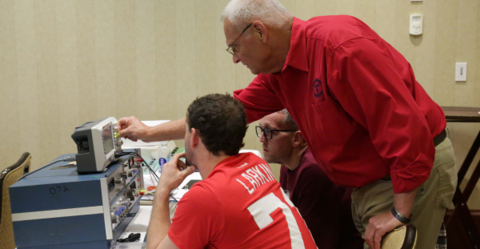
Recently, we visited the National Elevator Industry Educational Program’s (NEIEP) fair in Arlington, Texas alongside the members of IUEC Local 21. While at the event, we got a nice overview from NEIEP’s Head of Development, Lester White.

NEIEP has established a national educational program that is uniform across the country, so the apprentices all receive the same coursework regardless of which state they are enrolled in the curriculum. The apprentice program is set up as a four-year program with eight semesters.  Each semester focuses on different disciplines and has a respective final exam and then a comprehensive mechanics exam that the students must pass in order to become a mechanic.

Lester shared with us how he advises his students on how this program provides a pathway of choices for them to have careers in the elevator industry. From working in construction, being an adjuster (is that all just two things? NEIEP helps them reach their goals.

Lester shared with us the importance of this training, as it opens up pathways to have a career in the elevator industry. NEIEP not only covers all the basics that an apprentice needs to know, but also offers continuing education courses for those that want to go even further with their training and knowledge. “We have code courses, we talk about different safety issues and factors, how to keep you and your crew safe”, added Lester.

NEIEP also offers continuing education to the workers already working in the trade like code courses and safety topics. “If you want to be successful in this field, and I would say life, you have to continue to learn” says Lester.

ElevatorInfo was recently in Chicago and had the great pleasure of interviewing International Union of Elevator Constructors (IUEC) General President Frank J. Christensen and his dear friend Chris Gardner, whose rags-to-riches story was shared with the world in the hit movie The Pursuit of Happyness, starring Will Smith.

Frank and Chris are leaders working together to change the world. Specifically, their organizations – the International Union of Elevator Constructors and the Christopher P. Gardner Foundation – are uplifting children and young adults across the United States, helping them achieve their goals by offering significant guidance and mentorship, meaningful opportunities, and fundamental tools. They are transforming lives by literally setting young people’s careers in motion.

Keeping The American Dream Alive

With Labor Day upon us, ElevatorInfo engaged in a dynamic conversation with Frank and Chris about the American Dream – and what keeps it alive today.

The American Dream – something that Frank and Chris agree is an idea that every generation can take a little bit further and a little bit higher – is still possible thanks, in part, to the great careers found in the unionized building and construction industry.

Making it a reality

The Building Trades Unions, the International Union of Elevator Constructors, and The Christopher P. Gardner Foundation connect today’s youth with earn-as-you-learn apprenticeship training that leads to exciting careers – careers that offer family-sustaining wages, excellent health benefits, and retirement security.

“To get where you want to be in life – it takes hard work. It’s not luck,” said IUEC General President Frank Christensen. “Our role is to help guide young people. That’s our shared goal – the union and Chris’s foundation – we want to help men and women achieve their goals in life by giving them a hand up, by giving them guidance. Chris and I are doing everything we can to make their dreams a reality.”

With a smile, Chris Gardner added, “Luck is the dust created when opportunity and preparation collide.”

IUEC

North Carolina short-term rental property owners have a little over two months to implement improved safety standards for residential elevators included in legislation signed by Gov. Roy Cooper on Friday.

Cooper signed House Bill 619, sponsored by Rep. Timothy Moffitt, R-Henderson, to require owners of vacation cottages or similar short-term rentals to implement measures to improve the safety of residential elevators. The law was inspired by a child’s death at a beach home in Corolla last year.

“This law requires much-needed safety measures for elevators in short-term rentals, and while this action sadly can’t reverse the tragedy that killed Weston Androw, it does mean better protection to prevent future injuries and deaths,” Cooper said.

Weston’s Law is named after 7-year-old Weston Androw, who died in July 2021 after he was trapped between an elevator car and elevator shaft while visiting the Outer Banks with his family from Ohio. EMS workers quickly freed the child but were unable to resuscitate him.

The bill gives owners and landlords operating short-term rentals with residential elevators until Oct. 1 to reduce the gap between the landing and elevator car doors to no more than 4 inches, by installing a space guard on the landing floor, The Associated Press reports.

The bill also mandates minimum force requirements for elevator car doors and gates, which must be documented with the N.C. Department of Insurance.

Weston’s parents, Timeka and David Androw, advocated for the changes.

The U.S. Consumer Product Safety Commission issued a warning to vacation rental platforms, AirBnB, Vrbo, Trip Advisor and others to require owners to disable home elevators following Weston’s death.

CPSC Acting Chairman Robert Alder urged the companies in a letter to disable the elevators, describing how children “some as young as two, and as old as 12, have been crushed to death” by getting trapped in the gap between inner and outer doors of residential elevators. While several deaths have occurred, “others have suffered devastating and lifelong injuries,” according to the CPSC.

Alder called on the companies to immediately notify all renters of the potential hazard and to disable elevators with the dangerous gap until the issue is addressed.

In January, the CPSC announced three leading elevator manufacturers – Bella Elevator, Inclinator Company of America, and Savaria Corporation – agreed to voluntarily recall about 69,000 residential elevators due to the issue.

The recalls involved numerous models manufactured between 1979 and 2021.

“Industry and the CPSC still have work to do. We have not yet been able to reach agreements with all of the elevator companies to fix their residential elevators that pose the same potentially fatal entrapment hazard and in one case sued a company to force a fix,” CPSC Chairman Axexander Hoehn-Saric said in January. “As long as this hazard persists, I am committed to continuing this work and preventing future entrapment injuries and deaths.”

ElevatorInfo just had an opportunity to travel to Chicago to check out the International Union of Elevator Constructors (IUEC) Local 2 Annual Golf Outing. Hundreds of golfers from the Chicago area and across the country look forward to the outing each year, as the event is a perfect time to connect with old friends and contribute to finding a cure for diabetes.

Tom Karlya (Senior Vice President, Philanthropy and Union Liaison, Diabetes Research Institute Foundation) took time to speak with ElevatorInfo at this year’s outing. Karlya – also known as “Diabetes Dad” – had nothing but great things to say about his friends in the elevator industry and across the building trades unions.

“One of our biggest fundraisers is IUEC Local 2’s golf outing,” said Tom Karlya. “We are so grateful for the support of our brothers and sisters in the elevator trade. Any real, major research step forward in the diabetes world – a lot of it started at the Diabetes Research Institute. Local 2’s support is amazing – they’ve been with us every step of the way. Their money helps fund critical research, and eventually this research goes to bigger and bigger things.”

IUEC Local 2 has been actively supporting the Diabetes Research Institute for more than two decades.

“We have more than 460 golfers here. For an event of this scale, it takes a lot of good people to put it together. The golfers, the donors, the union members – each person plays an invaluable role,” said John Valone, National Coordinator with the Elevator Industry Work Preservation Fund and a former IUEC Local 2 Business Manager. “We’re not done until diabetes is cured.”

The energy throughout the outing is nothing short of contagious. Each golfer, event organizer, and supporter is focused on finding a way to beat diabetes (and having fun while doing so!). This year alone, the golf outing raised more than $70,000. In total, the Local 2 golf outing has generated more than $700,000 for the Diabetes Research Institute Foundation.

“It’s love. We’re supposed to do this in life – we’re supposed to take care of other people. It’s the right thing to do,” said IUEC General President Frank J. Christensen.

The Diabetes Research Institute houses teams of scientists, engineers, and clinicians with the expertise required to tackle diabetes from many angles. If you or your organization may be interested in getting involved with the fight for a cure for diabetes, please contact us here: www.iuec2.com

ElevatorInfo recently had a chance to sit down with Ovi Georgescu, an elevator constructor with TKE who currently maintains 170 elevators on the campus of the University of Texas at Arlington (UTA). During our conversation, he spoke to the importance of education and training, especially in a highly complex trade like the elevator industry. He also explained that not having the “right training” and the “right skills” is incredibly dangerous.

“In the elevator industry, you have to know what you’re doing – and that means workers must receive the proper training,” said Georgescu, now a member of the International Union of Elevator Constructors (IUEC) Local 21 in Dallas-Fort Worth, who has worked for a non-union company before and speaks to the tremendous difference in education and safety.

Georgescu goes on to argue that his apprenticeship – a 4-year apprenticeship with the National Elevator Industry Educational Program (NEIEP) – is what set him up for success. The training, he believes, is what keeps him safe every day.

As the resident mechanic at UTA, Georgescu explains that he loves his job for many reasons – and that between toolbox talks and safety meetings, he is always encouraged to make safety his top priority.

“Working for TKE and being a member of IUEC Local 21, I feel safe at work,” added Georgescu. “I’m constantly thinking about my own safety, as well as the safety of my colleagues and the riding public.”

If you have a story you would like to feature with us, contact us!

Building Pathways is a non-profit organization based in Boston, Massachusetts. Their mission seeks to increase the number of diverse workers in the building trades workforce. Building Pathways works with International Union of Elevator Constructors (IUEC) Local 4 Boston to help the recruitment, retention and advancement of under-represented groups in the building trades.

“Building Pathways offers equal education and equal pay to females and minorities” says, Pat Sampson, business representative and Financial Secretary for IUEC Local 4 (Boston).

ElevatorInfo recently sat down with Desalia Gomes, a first-year apprentice at IUEC Local 4 (Boston) who got her start through a pre-apprenticeship program with Building Pathways. In this video (part of her graduation speech was “Hey Local 4, I’m coming for you”), she shares her story of how the program provided an access point for her starting her dream job in the elevator industry. “It’s one of those things where you put it out into the universe and see it transpire, it’s like I did that. It makes me really proud to have something I was aiming for and to reach that goal”.

Part of what drew Desalia to the elevator trade where she began in April of 2021, like so many, is the wide range of knowledge and skills that elevator mechanics need to know. “Within the elevator trade you can be an electrician, you’re going to learn to put in floors, you’re going to learn carpentry, you’re going to learn how to weld, you’re going to be working ducts and machine rooms” says Desalia.

Also, the appeal of job growth and new opportunities inside of the Elevator Trade seem to equally excite Gomes, “I want to make sure I’m not stuck in one place, I want to make sure I have avenues for growth and there is no ceiling above my head”.

Benefits of Hiring IUEC Elevator Mechanics For Installations, Modernizations, and Maintenance

Whether you are interested in a new elevator installation, modernization or routine maintenance, you’ll want the elevator mechanics responsible for the job to be the best trained, knowledgeable, safe, and professional. The International Union of Elevator Constructors (IUEC) can provide you with the help you seek. When you choose to work with an IUEC-affiliated elevator company that hires IUEC elevator mechanics, you can rest assured that you will benefit from the best service available in the industry for any elevator installation and maintenance project you might have. 

Available in every city across the U.S., Canada, and Puerto Rico, IUEC-affiliated elevator companies are sure to provide you with qualified elevator mechanics that will meet and exceed any of your demands, regardless of their complexity or size. But why are IUEC mechanics better than all other elevator technicians?

Highest Quality Standards Maintained

Work done on your elevator, escalator, or other people-moving equipment always needs to be done with the utmost care. That means hiring qualified professionals who understand their trade and its demands and maintain the highest quality standards throughout their work.

Safety is a priority. Less liable to any work-related injuries, unionized elevator mechanics are certified in areas such as OSHA 10, OSHA 30, welding, scaffolding, signaling and rigging, forklifts, CPR, and first-aid, to name just a few. As a building owner, this ensures that you work with professionals who have their safety priorities in check and certified.

IUEC Unionized Mechanics Get Constant Superior Training

IUEC mechanics have completed a four-year college-level (and college-accredited) apprenticeship training program. This means they benefit from 576 hours of classroom instruction at over 100 sites across the country and a minimum of 8,000 hours of on-the-job learning under the guidance and supervision of National Elevator Industry Educational Program (NEIEP) or Canadian Elevator Industry Educational Program (CEIEP) certified elevator mechanics. 

During their training, the soon-to-be IUEC elevator mechanics benefit from constant interactions with IUEC Mechanics and NEIEP/CEIEP qualified instructors. Unlike other industries, where most of the training programs are bland and purely theoretical, here, students gain practical knowledge through On the Job Learning (OJL) along with hands-on labs and high-tech virtual simulators at their disposal throughout their training program. This ensures that both the theoretical and practical knowledge are embedded in their training experience and that they are fully confident in applying their skills when out in the field.  

Specialty Work and Professionalism

Elevator mechanics must be proficient in a multitude of skills to provide quality elevator services. Whether it may be an elevator installation, modernization, or maintenance, all tasks demand the elevator mechanic have a unique combination of skills. 

IUEC elevator mechanics are skilled in relay logic, solid state, electrical, mechanical, piping, welding work, and everything in between. There is nothing that they cannot do at the utmost standards of work.

Ongoing Maintenance and Service

From the construction of elevators or escalators to maintenance, repair, and modernization service, IUEC elevator mechanics continue to evolve and improve with continuing education. While the equipment is ever-changing, the IUEC mechanics hone their skillset to keep pace with technology.

Learning never stops for the IUEC elevator mechanic – it’s not just a job. It’s a career that spans over a lifetime and generations. The IUEC elevator industry continues its efforts to create an excellent workplace for veterans with opportunities to find fulfilling careers with family-sustaining wages.

Professionals Able to Always Meet Your Demand

Working with an elevator company that employs IUEC member elevator mechanics ensures that you are provided with professionals who always meet your demand, no matter the job complexity. What sets IUEC elevator mechanics apart is their skill, continual training, and level of expertise in multiple areas and their lifetime commitment to their trade.

You can rely on an IUEC-affiliated company for a safe and efficient service. The IUEC elevator mechanic’s skill set covers all aspects of the elevator industry.

If you are currently on the lookout for an elevator repair, elevator installation, elevator modernization, elevator maintenance, or specific service-related task, choosing to work with a company that employs IUEC elevator mechanics is the best choice you can make. It ensures that you work only with the best, most capable professionals in the elevator industry.

Get in touch now with ElevatorInfo to find out more about the IUEC-affiliated elevator companies available in your region and hire the qualified personnel you need.