(L-R): Mike Mintle, Chicago and Cook County Building and Construction Trades Council Secretary/Treasurer and Local 2 Member; John Valone, EIWPF National Coordinator and Local 2 Member; Gary Pipiras, Local 2 Vice President / Business Representative; Bobby Capuani, IUEC Organizer and Local 2 Member; Eric Crane, Local 2 Vice President / Business Representative; Tom Karlya, DRI Foundation Senior Vice President; Dr. Allison Bayer, Research Assistant Professor in the Department of Microbiology and Immunology at the Diabetes Research Institute, University of Miami Miller School of Medicine; Juan Gonzalez, Local 2 President/Business Manager and International Vice President; Rob Kennedy, Local 2 Business Representative; Kate Hickey, Local 2 Financial Administrator; Ed Christensen Sr., IUEC Regional Director.

International Union of Elevator Constructors (IUEC) apprentices and mechanics are fortunate to benefit from one of the best healthcare plans in the country through the National Elevator Industry Health Benefit Plan. This plan gives them access to a generous and comprehensive schedule of medical, prescription drug, mental health/substance abuse disorder, dental, vision, and hearing benefits. However, far too many of our members working in the elevator trade are diagnosed with diabetes. The Diabetes Research Institute Foundation (DRIF) is working to change that, and with the continued support of North America’s Building Trades Unions (NABTU) and the IUEC, they are closer to eradicating this devastating disease.

More than twenty years ago, a representative from the Diabetes Research Institute (DRI) attended an IUEC Convention in Toronto, Canada, as a guest speaker. He asked the people in attendance – how many of you in this room have a family member or close friend who has been diagnosed with diabetes? According to the IUEC Local 2 members who were in the audience that day, over ninety percent of the elevator constructors in the room raised their hands.

The DRI first came to the attention of the IUEC through NABTU, which has supported the DRI for more than 35 years. Their long-running, nationally-coordinated Blueprint for Cure: DAD’s Day and Labor of Love campaigns encourage members of the building trades to come together to support the DRI’s goal to find a biological cure for diabetes. Since NABTU began supporting the DRI, they have raised over $63 million dollars for diabetes research; NABTU’s website states: “Through bucket collections, walkathons, motorcycle rallies, golf tournaments, bowling tournaments, poker runs, and more, the Building Trades community raised the funds necessary to build the Diabetes Research Institute.”

Elevator constructor apprentices, mechanics, and IUEC leadership have been an integral part of making support like this possible. In 2022, as in past years, IUEC Local 2 in Chicago was one of NABTU’s top DAD’s Day donors. Deeply impacted by the words of the speaker in Toronto, Local 2 leadership brought that message home to their membership – so now, for more than two decades, IUEC Local 2 in Chicago has held an annual charity golf outing to benefit the work the DRI is doing to eradicate a disease which, according to statistics obtained by the National Institute of Diabetes and Digestive and Kidney Diseases (NIDDK),  affects more than 37 million people in the United States – over 11% of the country’s population.

Through the Local 2 Organization for Diabetes Research 501(c)(3) charity, IUEC members, their friends, families, and supporters from other IUEC Locals and the greater Chicagoland labor community have cumulatively raised hundreds of thousands of dollars for the DRIF. Sponsorships, entry fees, raffles, a hole-in-one challenge, and other activities during the event have provided many opportunities for the IUEC community to donate. Last year, more than 500 people attended the tournament. “We definitely want to thank all of the people who come out and participate, whether volunteers or golfers…anyone who supports the cause,” said Gary Pipiras and Eric Crane, who both serve as Local 2 Vice Presidents and Business Representatives.

Because of the success of the Chicago tournament, Local 2 has offered advice to other IUEC Locals and building trades members who want to set up golf outings for DRIF or other charitable causes in their areas. “IUEC 12 in Kansas City just reached out to us…we give them guidelines, I give them our flyer. We’ve helped the sprinkler fitters and bricklayers as well,” said Kate Hickey, Local 2’s Financial Administrator, who has been instrumental in the event’s planning for many years.

Local 2 IUEC president presents a donation of $71,000 to DRI

(L-R): Juan Gonzalez, Local 2 President/Business Manager and International Vice President presents a donation of $71,000 to Tom Karlya, DRI Foundation Senior Vice President and Dr. Allison Bayer, Research Assistant Professor in the Department of Microbiology and Immunology at the Diabetes Research Institute, University of Miami Miller School of Medicine.

ElevatorInfo visited IUEC Local 2 in Chicago on St. Patrick’s Day as they presented a donation of $71,000 to the Diabetes Research Institute and Foundation. IUEC Leaders from the Local, along with Mike Mintle, Chicago and Cook County Building and Construction Trades Council Secretary/Treasurer, and IUEC members involved in the organization of the annual charity golf tournament, gathered to personally hand the check to the DRI Foundation’s Senior Vice President, Tom Karlya, and its Director of Major Gifts, Brendon Steenbergen, along with and Dr. Allison Bayer, Research Assistant Professor in the Department of Microbiology and Immunology at the Diabetes Research Institute, University of Miami Miller School of Medicine.

Dr. Bayer, a cellular immunologist and leading researcher in the fight against autoimmune type 1 diabetes, gave a presentation on the research that’s being conducted at the DRI facility to the group and explained how this research could lead to a cure for diabetes. She began with an overview of what diabetes is and how it affects the body at the cellular level, then shared information about current studies, clinical trials, and the advancement of DRI’s research around finding a biological cure for diabetes.

Because the research is so involved, much of the DRI’s work is funded by large grants sponsored by large health-focused foundations like the Juvenile Diabetes Research Foundation (JDRF) and the National Institute of Health (NIH). So why is funding from groups like NABTU building trades councils and IUEC elevator constructors so important? In order to qualify for larger grants, researchers must first prove to potential grantors that the work they propose using the grant for is worth funding – meaning, they have to prove that they can get results. This requires they collect data, conduct preliminary test studies, and prepare detailed reports of their findings before they can apply for larger grants to advance the science.

Donations raised by the elevator constructors in Local 2 are given as ‘unrestricted’ funding so that the Diabetes Research Institute Foundation can immediately direct them toward their areas of greatest need. This is especially important to support the preliminary studies that make obtaining larger grants possible. “A lot of those initial studies that we need to get pre-clinical data for a clinical trial are supported by the foundation, said Dr. Bayer.

Tom Karlya explained, “A lot of times in academia, they put out an RFP (request for proposal), and then by the merit of what the proposed science is, they are awarded grants. What we do is we work directly with the scientists – every year, we meet with all of them – and we find out what looks promising. If we see something that looks promising that didn’t get NIH funding or funding from another source, we don’t want it to die on the vine, we don’t want it to just go away because it didn’t have the money. It’s like a catch 22 – you have to prove it to get the money, but in order to prove it, you need the money. What we do is we move the science forward.”

The building where Dr. Bayer and the other research scientists carry out their work, a 78,000 square foot research facility on the campus of the University of Miami in Florida, was built 100% by union labor, according to NABTU1. “Everything we receive goes to the institute. We don’t even have to pay rent for that building because of you guys,” said Tom.

1Source: https://nabtu.org/dads-day/

ElevatorInfo recently met with Jim Snider, Executive VP at Quality Elevator to talk about the advantages IUEC affiliation brings not only to the elevator constructor mechanics and apprentices his company employs but to his overall business.

Jim has worked in the elevator industry practically all his life. After graduating from high school and starting out as an electrician, he became an installer in new construction at Haughton Elevator. Around the time that Haughton was acquired by Schindler in the mid-1980s, Jim passed his mechanic’s test and transferred to Quality Elevator, a local/regional independent company based in Bladensburg, MD. Jim spent most of his career as a field mechanic there before transitioning to a management position. Today, Jim is the Executive Vice President for Quality Elevator Company, which has, according to its website, “grown to become one of the largest independent elevator service contractors in the Maryland, Virginia, and District of Columbia Region.”

At the top of the list of advantages for elevator companies affiliated with the IUEC, is the superior education and training all IUEC elevator mechanics receive, starting with their apprenticeship through the National Elevator Industry Educational Program (NEIEP) and continuing on through their years in the trade as mechanics. “We invest heavily in training, and the union really helps us out with that area of the industry. They have an excellent educational program,” Jim said.

Because their NEIEP education provides hands-on training and a broad base of knowledge covering the fundamentals of what elevator mechanics need to know to be the most skilled, proficient, and safety-focused in the industry, Jim is able to craft the additional safety training his company provides to the specifics of what his mechanics need based on the type of work they do and equipment they work with every day.

“The NEIEP program is one of those things that sets Quality Elevator and all of the other (IUEC-affiliated) companies apart,” he said. “They provide online training, they provide in-person training, they have shops (including) welding shops… you won’t find any other industry that I know of that provides this training at the level that we provide and work with the union on.”

Knowing his employees are taken care of by a generous benefit plan is also an advantage of being an IUEC-affiliated company. The IUEC provides the best health care coverage there is for its members and their families, with no additional premium costs. “Their healthcare is paid for – it doesn’t come out of their paychecks,” he said.

Through the National Elevator Industry Health Benefit Plan, IUEC elevator constructors and their families have access to a generous and comprehensive schedule of medical, prescription drug, mental health/substance abuse disorder, dental, vision, and hearing benefits. And once an IUEC member is eligible for benefits under the Health Benefit Plan, full coverage is also extended to the member’s spouse and children.

Beyond the health care plan, Jim talked about the three levels of retirement IUEC mechanics enjoy – including a pension, 401K, and annuity. “They can retire very well after this,” he said.

The National Elevator Industry Pension Plan is one of the largest defined benefit multiemployer pension plans in the US and is funded by contributions employers make to the Pension Plan for each hour a member works. So for every hour an elevator constructor works for a contributing employer like Quality Elevator Company, that individual’s monthly lifetime pension benefit grows. It’s especially important that in an environment of troubled Pension Plans, since its inception in 1962, the NEI Pension Plan has been secure and has never failed to meet its financial obligations.

The Annuity 401(k) Plan is one of the largest defined contribution multiemployer pension plans in the nation. IUEC members’ retirement savings in the Annuity 401(k) Plan grow through contributions employers make to the Plan for each hour the IUEC member works (their “Annuity Account”), and voluntary pre-tax wage deferrals (401(k) elective deferrals) each IUEC elevator constructor chooses to contribute to the Plan (their“401(k) Account”). IUEC elevator constructors are always fully vested in their Annuity Accounts and 401(k) Accounts. This great source of financial security is in addition to the pension IUEC members receive through the Pension Plan and Social Security.

Superior education and training, an excellent health care plan and the security of a reliable plan for retirement allow the elevator constructor apprentices and mechanics who work for Jim and his team at Quality Elevator Company to focus on getting their work done effectively and efficiently without the additional worries or distractions that workers at companies without these benefits may face.

To learn more about the benefits of becoming an IUEC-affiliated elevator company or hiring one to install, service, troubleshoot, modernize, or repair your conveyance equipment, contact us here.


Last week, the ElevatorInfo site launched a new page with information for wind turbine owners and operators about the work International Union of Elevator Constructors (IUEC) members from across the United States are doing with equipment in the wind power industry. From Deepwater Wind’s Block Island Wind Farm off the coast of Rhode Island to land-based wind farms in California, Pennsylvania, Nebraska, Minnesota, and beyond, our skilled apprentices and mechanics are helping to build and maintain the elevator systems within the nation’s fastest-growing clean power energy sector.

According to a report from the International Energy Association, in 2021, electricity generated from wind power (globally) increased by 17% over the previous year, which was the highest rate of growth among all renewable power technologies1. And for the United States, the US Department of Energy reported that in 2021, wind power accounted for 32% of U.S. energy capacity growth2. As the wind power industry continues to grow, there will be an increased need for experienced technicians to take care of the complex machinery that generates it.

Working on the conveyance systems housed within wind turbines is a natural fit for IUEC elevator constructors, who have been installing, servicing, repairing, and modernizing equipment like this for more than 150 years. Learning how to work safely at heights and in all different kinds of challenging environmental conditions is an integral part of their work. The comprehensive education and training they receive from the National Elevator Industry Educational Program (NEIEP) provides an excellent starting point, giving them broad foundational skills (in elevator and escalator installation, maintenance, and repair) during apprenticeship – along with continuing education courses in focused topics which allow them to develop the specialized skills needed for the wind power industry. Given the knowledge and experience required to perform the tasks of an elevator constructor, it’s not a surprise that when wind turbine owners and contractors are looking for qualified people to work on their equipment, they look to IUEC mechanics.

Based on an assessment of the core competencies required for the elevator trade, by the time IUEC mechanics complete their apprenticeship and earn their journeyperson’s card, they must:

  • Be able to work safely at extreme heights
  • Have advanced mechanical aptitude
  • Possess the ability and willingness to follow instructions
  • Have sharp analytical skills
  • Have the ability to work effectively in small teams
  • Be self-motivated/directed and able to work with minimal supervision
  • Know and implement safety procedures for working with high and low voltage wiring
  • Troubleshoot control wiring and perform diagnostics
  • Work on hydraulics and pipe fitting
  • Understand key fundamentals and advanced concepts of working with electromechanics and motors

IUEC mechanics don’t only rely on the broad base of knowledge gained during their time in the NEIEP apprenticeship program, they actively seek out ways to advance their learning to stay current with changes in industry technology. It’s through NEIEP’s continuing education programs that they develop the specialized skills they need to work on all different kinds of conveyance equipment, including wind industry equipment. And if members have training needs that are especially unique, the IUEC seeks out partnerships with other training providers who can fulfill them.

ElevatorInfo recently shared an article about a new collaboration between the IUEC’s education program and Survival Systems USA in Groton, CT. Working with Survival Systems has made it possible for the IUEC to provide Global Wind Organization (GWO) Basic Training to elevator technicians/constructors who install, maintain, service, and repair wind industry equipment – including a Sea Survival course that involves getting into the water to learn safety skills necessary for working with offshore equipment.

Certifications IUEC mechanics who complete the Survival Systems training program earn include:

  • GWO BST-1005 Basic Safety Training
  • GWO BST-WAH-1002 Work at Height
  • GWO BST-MH-102 Manual Handling
  • GWO BST-FA-2002 Medic First Aid + Trauma
  • GWO BST-FA-101 Fire Awareness
  • GWO-SS GWO Sea Survival
  • GWO-EFA Enhanced First Aid
  • GWO-ART Advanced Rescue Training

IUEC members who work on wind turbine elevators have also participated in the High Angle Rescue Training program at Kalamazoo Valley Community College in Michigan.

This spring, staff from the IUEC and the Elevator Industry Work Preservation fund will be visiting, speaking, and exhibiting at a number of major wind energy conferences, including:

American Clean Power’s Operations, Maintenance and Safety Conference 2023
Wed, Mar 1 – Fri, Mar 3
Marriott World Center
Orlando, Fl

Offshore Wind California’s Pacific Offshore Wind Summit 2023
Mon, May 8 – Wed, May 10
SAFE Credit Union Convention Center, 1401 K St
Sacramento, CA

American Clean Power’s Cleanpower Conference and Expo
Mon, May 22 – Thu, May 25
New Orleans, LA

American Clean Power’s Offshore Windpower Conference
Tue, Oct 3 – Wed, Oct 4
Hynes Convention Center, 900 Boylston St
Boston, MA

If you are an owner, operator, or contractor for offshore or land-based wind turbines, don’t jeopardize your equipment by allowing inexperienced mechanics to service the conveyance systems within them. Contact us here to be connected with an IUEC-affiliated company.

 

References:
1. “Wind Electricity,” accessed February 23, 2023, https://www.iea.org/reports/wind-electricity
2. “DOE Finds Record Production and Job Growth in U.S. Wind Power Sector,” accessed February 23, 2023, https://www.energy.gov/articles/doe-finds-record-production-and-job-growth-us-wind-power-sector.

During a recent trip to Chicago, Illinois, ElevatorInfo had the chance to sit down and talk with Nate Hefner, a U.S. Veteran working as an elevator mechanic in Chicago.

Nate did not always plan for a career in the elevator trade; in fact, his degree is in Architecture. After transitioning out of active duty as a member of the Army National Guard, he knew that he never wanted a job where he would be forced to sit behind a computer or work in an office all day. A close friend and fellow Veteran who is a member of the International Union of Elevator Constructors (IUEC) Local 2 in Chicago suggested Nate check out the elevator trade. Right away, Nate knew that it would be a good fit.

“My favorite part of my job is actually working with my hands,” Nate explained. “That’s why I really like new construction… it’s more hands-on – measuring, beating things with a hammer, and actually building something that was not there when you got to the job a couple of weeks before.”

When asked about what makes him good at his job, Nate was quick to give a shout-out to the National Elevator Industry Educational Program (NEIEP). While other elevator training programs in the industry are offered via correspondence course, NEIEP is a four-plus year USDOL-Registered Apprenticeship, held to rigorous standards. Weekly classroom training that incorporates hands-on practical labs and virtual simulations administered by some of the best-trained instructors in the industry are what sets the IUEC’s program apart from the rest. “Once you graduate (from) the NEIEP program and you take that (Mechanic Exam) test, you know you can start day one of building that elevator without having somebody tell you how,” said Nate. “NEIEP has taught you how to build that elevator safely.”

From foundational classes covering the basics of working in the elevator trade to advanced training modules on troubleshooting the complex systems elevator constructors encounter on the job daily, NEIEP provides IUEC members with the knowledge and skills they need to do their jobs thoroughly, efficiently, and above all, safely. In a field with as many potential hazards as this one, safety must be a central component of any training program. This is why the NEIEP apprenticeship begins with a safety course for probationary members, and has included in its required apprenticeship training certifications in OSHA 10, Scaffold and Access Industry Association’s (SAIA) Competent Person Training for Framed Scaffolds, Scaffold and Access Industry Association’s (SAIA) Training Program for Suspended Scaffolds, American Heart Association Heartsaver First Aid CPR AED, and Certified Signal Person and Rigger (Level 1), an industry-specific ANSI/ANAB accredited certification in rigging and signaling.

The NEIEP apprenticeship curriculum covers not only the individual steps involved in performing a task but guides students through an in-depth exploration of electrical and mechanical theory and application. Once an apprentice successfully completes the eight-semester program, logs 8,000 hours of work under the supervision of an experienced mechanic, and passes the capstone validated Mechanic Exam, they have access to more than 40 online and classroom-based continuing education courses. What’s more, courses completed during the NEIEP apprenticeship have been recognized as equivalent to college-level learning by a number of accredited colleges and universities who give college transfer credit to NEIEP graduates who want to earn associate and bachelor’s degrees in fields such as Construction Management, Project Management, Applied Sciences, Engineering Technology, Education, and more. This advanced training benefits every elevator constructor in the IUEC along with their colleagues, employers, building owners, and the riding public.

While Nate came into the elevator trade through the standard recruitment process, the IUEC also supports Veterans as they transition to a career in the elevator industry through a partnership with the national nonprofit organization Helmets to Hardhats. Helmets to Hardhats connects military service members with training and education programs in the building trades, providing veterans with career opportunities through federally-registered apprenticeship programs like the one offered by NEIEP. Through Helmets to Hardhats, IUEC Locals across the United States offer Veterans priority status during Apprenticeship recruitment.

In the video, Nate highlighted how the safety-focused, comprehensive classroom courses he completed during his NEIEP Apprenticeship prepared him to do his job well, keeping his customers and his company satisfied. His main point? That the practical, hands-on learning he participated in in the classroom prepared him with the skills he needed to challenge the demands of his work in the field. “You have to pay attention to what you’re learning because it applies to the real world,” he said.

Elevator constructor safety equipment

When working on elevators, escalators, or other types of conveyance equipment, safety must always be the number one priority. Most work-related injuries suffered by elevator technician/constructor mechanics and apprentices are caused by distractions, complacency, overconfidence, incomplete or improperly worn personal protective equipment (PPE), or a lack of safety training.

In an environment where work is done in confined spaces (including permit-required confined spaces), at elevated heights, or in close proximity to adjacent equipment, high voltages, and hazardous chemicals/materials, it’s essential that all PPE and items in your safety bag are checked and procedures and processes are reviewed before beginning any work on a job site or specific task.

Fall Protection

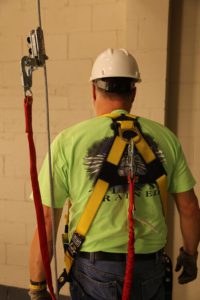
Elevator constructor safety equipmentThe Personal Fall Arrest System (PFAS) is comprised of three main pieces: an anchorage point, a body harness, and a lanyard. It is the standard mandatory PPE that elevator technician/constructor mechanics and apprentices must use whenever working where a fall of 4’ or greater (general industry) or 6’ or greater (construction) is possible. Always ensure you select appropriate engineered anchor points and use your lifeline or other anchoring devices in accordance with the instruction manual, Occupational Safety and Health Administration (OSHA) Regulations and Standards, and your company’s policies and procedures. Reading and understanding these documents could be the difference between life and death.

Of OSHA’s “Focus Four” – which details the four most common causes of worker fatalities on construction sites – falls account for 33.5% of worker mortalities, placing them first on the list when it comes to dangers in the workplace.  In 2021, OSHA ranked inadequate fall protection as the most common safety violation that led to injuries and fatalities.

Fall protection gear, along with safety nets and standard guardrails, can save your life. Be diligent and take time to inspect each piece of fall protection gear before starting any work on an elevator, escalator, or other types of conveyance equipment.

Eye and Face Protection

Eight of the top ten most frequently violated standards cited by OSHA involve inadequate or improperly worn eye or face protection. Elevator technicians/constructors must always have eye and face protective gear in their safety bags to protect against injuries from cutting, welding, dust, debris, or other objects.

Thousands of workers in the building trades are blinded each year; many of these injuries could have been prevented had the correct eye and face protection been worn. Always wear your safety glasses, goggles, face shields, and welding helmets (when required) to stay safe on the job.

Lockout/Tagout (LOTO) / Test and Verify (Mechanical Energy)

Lockout/tagout (LOTO) and test and verify procedures ensure that the equipment that elevator technicians/constructors are working on is not energized and does not start up during maintenance, repair, or troubleshooting.  LOTO procedures protect workers from electrical energy as well as other types of stored energy. In the elevator industry, common LOTO procedures can include using pipe stands to support a column of oil holding up hydraulic equipment or using rope grippers on traction equipment. Unless you are working on a system that must remain energized during troubleshooting – and taking the precautions required by code and your elevator company’s safety policies in order to do so – you must always lockout, tagout, test, and verify your equipment to remove the stored electrical, mechanical, gravitational, hydraulic, or pneumatic energy that could put you at risk of serious injury or death.

Lockout devices include keyed or combination locks that when installed prevent pieces of equipment from starting or moving. Tagout devices are tags that are securely attached to the equipment to indicate that both the equipment and the energy-isolating device are inoperable, as well as provide contact information for the individual who locked out and tagged out the equipment. When a piece of elevator equipment has several isolation points, a group lockout box (sometimes called a LOTO box) or group lockout device must be used before it can be securely locked out.

In 2021, lack of control of hazardous energy placed seventh on OSHA’s list of its most frequently violated standards. According to the administration, the most common workplace injuries from LOTO misuse are electrocution, scalding, chemical burns, crushed limbs or digits, and amputations.

LOTO / Test and Verify (Electrical Energy)

When providing elevator services, elevator technicians/constructors often have to work with electricity. Electrocutions account for 8.5% of construction worker deaths and are number three on OSHA’s “Focus Four” list. Always make sure the equipment you are working on is grounded, and always lockout/tagout and test and verify any electrical equipment in accordance with OSHA Regulations and Standards, local, state, and national code requirements, and your company’s policies and procedures.

If you are installing or servicing AC/DC equipment, ensure that you are wearing OSHA-approved PPE to protect you from electrical hazards.

Safety Resources and Training

Before starting any elevator installation, modernization, repair, or maintenance procedures, always take an assessment of the workplace’s potential physical or health hazards and ensure that you and your coworkers know what needs to be done to minimize your risks. While it’s your employer’s responsibility to provide you with proper safety equipment, training, and PPE, you must know how and when to use it, and you must commit to using it correctly every time.

Through the National Elevator Industry Educational Program (NEIEP) and the International Union of Elevator Constructors (IUEC), members are provided with basic elevator constructor safety training that includes up-to-date OSHA-certified courses covering equipment, processes, and procedures they must be ready to apply on the job site. Safety training is one of the best benefits all elevator constructor mechanics and apprentices get from the IUEC, its union-affiliated employers, and NEIEP. (Employers are required to provide more comprehensive safety training.) OSHA’s general duty clause covers the requirements of the employer and employee.

To learn more about that, as well as union working conditions, elevator constructor retirement benefits, healthcare coverage, and annuity and 401(k) savings plans, head over to our hub of resources for elevator mechanics.

The National Elevator Industry Educational Program (NEIEP) recently joined members of the International Union of Elevator Constructors (IUEC) Local 133 and staff from the Elevator Industry Work Preservation Fund (EIWPF) in Austin, Texas, for an informational fair showcasing the industry’s most comprehensive education and training program for elevator technicians/constructors. NEIEP Development staff and Area Coordinators traveled from the program’s new, state-of-the-art Instructor Training Center in Warwick, Rhode Island and IUEC Locals from across the country to set up the event in the capital of the Lone Star State.

Along with having what one ElevatorInfo writer would argue is the best BBQ in the country, Austin is home to a number of industry stakeholders. Elected officials, company representatives and owners, building owners, contractors, and elevator constructors all visited the fair to learn about the education program and see demonstrations of NEIEP’s new and upcoming course materials for IUEC apprentices and mechanics. Through state-of-the-art classes held on-site in locations across the US – and online platforms IUEC members can access from their homes – NEIEP training gives IUEC elevator constructors the foundational and specialized skills they need to safely and efficiently build, modernize, maintain, troubleshoot, and repair complex pieces of conveyance machinery including elevators, escalators, moving walks, Automated People Movers, and more.

Between stops at each of the stations at the event, we had opportunities to speak with lawmakers interested in the value of USDOL-Registered Apprenticeship training, company representatives who employ the talented elevator constructors coming out of NEIEP, and individuals who help to make decisions as to which elevator contractor is the best fit for a particular project. We were also able to speak with three attendees who are currently working as elevator constructors in the field for TK Elevator.

Jarred Baker, Bobby Harper, and Pat Coker all traveled out to the NEIEP fair in Austin to meet Lester White, NEIEP’s Department Head of Development, and some of the talented subject matter experts who develop and implement the curriculum and hands-on lab materials featured in NEIEP’s new and upcoming training. All proud members of IUEC Local 133, the elevator constructors we spoke with shared with us how they valued their work, were enthusiastic about the industry as a whole, and wanted to show their support for the program that sets up IUEC members for safe, successful careers.

Jarred told us about the relationships he’s built with his IUEC brothers and sisters, emphasizing how the people he works with always look out for each other and always have each other’s backs. In a trade where elevator technicians/constructors routinely encounter a myriad of hazards on the job site, this is especially important. Bobby, a third-generation elevator constructor, agreed with Jarred and went on to share how important it is to be able to talk to others in the trade – people who know exactly what challenges elevator constructors face in their work with the complex equipment and systems they work with daily.

Both Jarred and Bobby touched on the impressive benefits package the IUEC provides to member elevator constructors.  When comparing the IUEC’s benefits packages to others, Pat described it as “the best in the country.” Through the National Elevator Industry Health Benefit Plan, IUEC members and their families have access to a generous and comprehensive schedule of medical, prescription drug, mental health/substance abuse, dental, vision, and hearing benefits. Once an IUEC member is eligible for benefits under the Health Benefit Plan, full coverage is also extended to the member’s spouse and children with no additional premium costs.

In addition to providing an extensive health care coverage plan, the IUEC worked with employers to establish the Elevator Constructors Annuity and 401(k) Retirement Plan – one of the largest defined contribution multiemployer pension plans in the nation. This is in addition to the pension IUEC members receive through the Pension Plan and Social Security. With the National Elevator Industry Pension Plan – one of the largest defined benefit multiemployer pension plans in the US – as early as age 55, a member with 5 years of service can retire and begin receiving a monthly lifetime pension benefit from the Plan that cannot be reduced.

“This trade will provide you with a great future,” Pat added. “Sky’s the limit.”

To learn more about the benefits package IUEC elevator constructors receive, visit https://www.elevatorinfo.org/elevator-technicians

The International Union of Elevator Constructors (IUEC) has recently worked in collaboration with Survival Systems USA in Groton, CT, to offer Global Wind Organization (GWO) Basic Training to elevator technicians/constructors who install, maintain, service, and repair wind industry equipment. According to Survival Systems, the GWO Basic Safety Training program (GWO-BST) “was created as the safety standard for those working at height in the wind industry. It is globally recognized and ensures that any GWO-BST certificate holder has demonstrated competence and proficiency.”

The United States Office of Energy Efficiency & Renewable Energy estimates that the average wind turbine is typically between 300 – 500 feet tall1. That would be a very big ladder for a wind service technician to have to climb to access the nacelle, which is the turbine’s electromechanical system comprised of the generator, turbine shaft, gearbox, and other components. This is a task that must be carried out regularly, as this complex and sensitive equipment requires regular maintenance and occasional repair. In order to make these trips safer and more efficient, a good percentage of wind turbines are equipped with elevators inside their towers. Because these types of elevators are built, maintained, serviced, and repaired by elevator constructors who have been doing this work for 125 years, it was a natural fit for them to continue to work safely on conveyances within this new equipment.

Today, highly-trained elevator mechanics from across the United States not only keep wind turbine elevators running, they do it efficiently, and above all else, safely. IUEC-affiliated companies currently maintain wind turbine elevators from the west coast all the way to the east coast, including those at Deepwater Wind’s trailblazing Block Island Wind Farm, the country’s first commercial offshore wind farm.

Through the new training program at Survival Systems USA, elevator technicians/constructors who work on wind technology equipment become certified in the following areas:

  • GWO BST-1005 Basic Safety Training
  • GWO BST-WAH-1002 Work at Height
  • GWO BST-MH-102 Manual Handling
  • GWO BST-FA-2002 Medic First Aid + Trauma
  • GWO BST-FA-101 Fire Awareness
  • GWO-SS GWO Sea Survival
  • GWO-EFA Enhanced First Aid
  • GWO-ART Advanced Rescue Training

This training is in addition to the four-plus year USDOL-Registered Apprenticeship training program that IUEC members complete through the National Elevator Industry Educational Program (NEIEP). NEIEP apprenticeship includes eight semesters of classroom instruction along with 8,000 hours of supervised on-the-job learning. The intense, safety-focused core curriculum covers all facets of erecting, constructing, installing, altering, testing, repairing, and maintaining elevators, escalators, moving walks, and other related conveyance equipment.

IUEC members’ competencies include:

  • Ability to work at height
  • Mechanical aptitude
  • Ability to follow instruction
  • Analytical skills
  • Ability to work effectively in small teams
  • Self-motivated/directed
  • High/low voltage wiring
  • Control wiring and diagnostics
  • Hydraulics and pipe fitting
  • Electro-mechanics and motors

All of these skills transfer easily to the wind industry.

In addition, during their apprenticeship, IUEC members earn certifications in OSHA 10-hour for General Industry and Construction, American Heart Association Heartsaver First Aid CPR AED, Competent Person training for Framed and Suspended Scaffolding (through the SAIA), and industry-specific crane rigging and signaling. Our CSPR Rigging and Signaling certification is accredited as a 17024 Personnel Certification Program by ANSI and is therefore held to the most rigorous standards in the industry. The process used by ANSI to accredit certification bodies is based on an international standard (ISO/IEC 17011). Adherence to a rigorous internationally recognized accreditation process ensures that the ANSI process conforms to the highest accreditation standard, and represents the best practices in accreditation. ANSI is the only personnel certification accreditation body in the United States to meet nationally accepted practices for accreditation bodies.

All apprenticeship training and continuing education courses, including those conducted at Survival Systems USA in Connecticut, are covered by members’ education benefit, so there are no additional out-of-pocket costs for IUEC members to attend.

Wind power generation is a global industry, and safety is the number one priority for companies operating within this space. Compare the specific skills needed for installation, repair, maintenance, and inspection of wind turbines against the checklist of core competencies of IUEC mechanics –the skills IUEC members master during their training and apply in their work with a broad range of conveyance equipment meet and exceed those required by the wind industry. IUEC mechanics have the education and experience necessary to fulfill the needs of the wind power industry; this new collaboration with Survival Systems USA will equip our mechanics with the specialized skills required to take wind technology to new heights.

1 “Wind Turbines: the Bigger, the Better” Office of Energy Efficiency & Renewable Energy, accessed January 23, 2023, https://www.energy.gov/eere/articles/wind-turbines-bigger-better#:~:text=A%20wind%20turbine’s%20hub%20height,as%20the%20Statue%20of%20Liberty!

The International Union of Elevator Constructors’ National Elevator Industry Educational Program (NEIEP) has recently opened the doors of a brand new, state-of-the-art, 98,000-square-foot instructor training center in Warwick, RI. Conveniently located just a 3-minute drive from Rhode Island’s T.F. Green Airport, the facility will train classroom and distance learning teachers from across the United States.

For more than ten years, Lester White, Department Head of Development has led the NEIEP Development staff in the creation of new courses along with an update of the program’s existing curricula to meet the rapidly-changing needs of the elevator industry. In the video, you will see footage of the new building and hear Lester speak more about the exciting things going on at NEIEP.

It’s not enough to simply write new textbooks – the hands-on learning that takes place in NEIEP classrooms must be taught by instructors who are thoroughly trained in how the complex lab equipment used in NEIEP courses functions, and knowledgeable about the most relevant pedagogical methods for communicating that information to students. To ensure NEIEP instructors are at the top of their game, the program has been bringing them to NEIEP headquarters for training for some time.

Until the NEIEP Instructor Training Center opened its doors in late 2021, instructor training generally took place in hotel conference rooms or at the program’s headquarters building in Attleboro Falls, Massachusetts. As NEIEP grew from a generalized training course to a nationally-recognized, US Department of Labor-Registered Apprenticeship – and went from offering a couple of Continuing Education courses for experienced mechanics to dozens of classroom-based and online courses for journeypersons – physical space at the headquarters building became increasingly limited. Locals all across the country were putting in requests to send their NEIEP instructors to the popular Basic and Advanced Train the Trainer teaching skills programs, as well as training on the specialized lab equipment used in Apprenticeship and Continuing Education courses.

By the mid-2010s, virtually all of these courses were being conducted at airport hotels in Rhode Island. It worked for the most part, but it meant that any scheduling of classroom space had to be done a year or more in advance and that NEIEP’s Development Team had to work around the hotel’s limitations for space and room availability. Plus, all of the lab equipment had to be brought on trucks to and from the hotel, where it was set up and broken down again and again, necessitating additional staff time as well as causing wear and tear on sensitive lab components. After several years of working around these limitations, it became clear that a different solution was needed.

To meet the growing need for instructor training in the elevator industry, NEIEP purchased a new building out by T.F. Green International Airport. Long used as a storage facility for boats, cars, and other equipment, the building was large, sparse, and had tremendous possibility. After working with a local architecture firm that had extensive experience building educational and commercial spaces, final plans for the design of the new NEIEP Instructor Training Center were approved. Construction began in the early months of 2020, just as the country was shutting down in response to the Covid-19 pandemic. Amazingly, the team was able to set up a safe environment so that the tradespeople could continue their work on the building in accordance with state, local, and national restrictions, and ultimately finish construction of the project ahead of schedule and under budget.

Today, the NEIEP Instructor Training Center is buzzing with activity. When ElevatorInfo visited, staff from the Elevator Industry Work Preservation Fund were leading an OSHA 500 course to certify NEIEP instructors to teach OSHA 10 certification courses to Semester 100 and Continuing Education students all throughout the country. In another area of the building, NEIEP instructors were learning how to teach Continuing Education courses using the Valve Simulator, which teaches elevator constructors how to make sensitive adjustments to hydraulic valve equipment in a safe, controlled environment before performing this complicated work in the field. In another classroom, they were being trained on how to conduct courses using new motor labs for a Continuing Education course on Motor Alignment. And in yet another classroom, new teachers were learning about the fundamentals of pedagogy and classroom management in Basic Train the Trainer.

This year, more than a thousand IUEC members will spend time at the facility getting prepared to teach all eight semesters of the Apprenticeship Program and certify elevator constructor apprentices and mechanics in American Heart Association Heartsaver First Aid CPR AED, Scaffold and Access Industry Association (SAIA) Competent Person for Framed and Suspended Scaffolding, forklift operation, and more.

The new NEIEP Instructor Training Center is something every IUEC member should be proud of. It ensures our instructors will continue to be the best-of-the-best, most highly trained and qualified in the elevator trade. Because the quality of our educational offerings is so high, NEIEP credits are recognized as college-level learning and can be converted to up to 58 transfer credits through partnerships with a number of accredited colleges and universities across the United States. And all NEIEP courses are covered by IUEC members’ education benefit, so there are no additional costs for apprentices or mechanics to attend.

If you find yourself in the Ocean State, stop by and visit Lester and NEIEP’s Development team at the NEIEP Instructor Training Center.

For more information about the most comprehensive education program in the elevator industry, check out https://www.neiep.org/bst-Default.aspx.

ElevatorInfo recently sat down with Desalia Gomes, a second-year elevator constructor apprentice at @International Union of Elevator Constructors (IUEC) Local 4 in Boston who got her start through a pre-apprenticeship program for the union building trades at Building Pathways. “Having taken this road is super-exciting. My career is exceptional,” she says.

For several years, IUEC Local 4 has partnered with the Boston-based nonprofit organization to improve recruitment, retention, and advancement strategies for under-represented groups in the elevator industry. For people who are new to the building trades, pre-apprenticeship programs like this one provide a solid foundation in the basics of working in the construction industry.

Building Pathways’ mission is to increase the number of diverse workers in the building trades workforce, particularly women, people of color, and young adults. Their pre-apprenticeship program provides over 200 hours of career readiness and occupational skills training, along with case management and placement services to help their students become competitive applicants during the recruitment process for union construction trades, including electricians, carpenters, bricklayers, sheet metal workers, elevator constructors, laborers, ironworkers, drywall finishers, and more. In addition to teaching them things like how to wear PPE and use basic hand and measurement tools, the program connects students with referrals to community resources including childcare, transportation, and housing. By the time they graduate from training, they’re ready to begin careers in the union building trades.

In the video posted here, Desalia shares the story of how Building Pathways provided an access point for her starting her dream job in the elevator industry. Like many of the people who pursue careers in this trade, Desalia was drawn in by the challenge of developing the wide range of knowledge and advanced skill set that elevator mechanics need to be successful. “I knew I would never be bored,” she says. “You’re going to learn how to put in floors or do carpentry, you’re going to learn how to weld… you have the ability to do all of the different trades.”

The appeal of job growth and new opportunities inside of the elevator trade seem to equally excite her. “I want to make sure I’m not stuck in one place… I want to make sure I have avenues for growth… there is no ceiling here.”

For more information about the Building Pathways pre-apprenticeship program, visit their website at https://buildingpathwaysma.org/pre-apprenticeship-program/

“The first thing that’s important here at TK Elevator is the safety of the mechanics, and that’s our first priority, always, every day,” says Mary Salvo, service superintendent for IUEC signatory contractor TK Elevator. ElevatorInfo recently met with Mary in Chicago, Illinois, to talk about strategies she uses to ensure the mechanics on her team work safe and make it home to their families at the end of each day.

Working with 12 mechanics out of @IUEC Local 2, Mary knows how important it is to keep safety first and foremost. Whatever TK Elevator’s mechanics need in order to do their jobs – from parts and PPE to help with safety audits – Salvo is there to help. “They call me and tell me they might need an extra person, or they need a part, or whatever the case may be,” she says. “I carry PPE in my truck in bins – whether it be gloves, glasses, hand sanitizer… all the PPE is on the truck. So as I go out, I bring them whatever they may need.”

Prioritizing safety by staying prepared is part of what’s made Mary a valued employee of TK Elevator for the last 17 years. She cited weekly toolbox talks with mechanics that combine company-specific safety training, safety alerts provided by the IUEC, and conversations about how to improve jobsite safety as a way to make sure everyone is focused on working safe. “We have a toolbox talk every Tuesday (to) go over incidents that have happened, and use some of the scripts from the IUEC that they send over letting us know of any accidents…we get phone calls from mechanics who pull out their stop card if they don’t feel that they can do the job safely and require another mechanic.” Having this feedback from the IUEC and mechanics helps Mary guide the discussions to ensure everyone on the team is aware of specific risks they may encounter and knows what steps they need to take to protect themselves, their coworkers, and the riding public.

Because TK Elevator employees received their initial training through the National Elevator Industry Educational Program (NEIEP) – a rigorous, USDOL-registered apprenticeship – they came into the trade with a solid foundational knowledge of the industry’s safest and most well-established work practices. Core classes in elevator industry-specific jobsite safety, along with third-party certifications including OSHA 10, SAIA Competent Person Training for Framed and Suspended Scaffolds, American Heart Association Heartsaver First Aid CPR AED, and an ANSI-accredited certification in Rigging and Signaling ensure that IUEC mechanics have the knowledge, skills, and abilities they need to be the safest and most efficient workers in the industry.

As the mechanics’ point of contact with TK Elevator, having a strong relationship with the IUEC is vital. From coordinating toolbox talks to seeking answers about important on-the-job issues, building trusted partnerships between the union and its signatory contractors helps keep things running smoothly and safely.

“The relationship is strong and it has to be strong,” said Salvo. “We’re grateful that we have the IUEC.”